


















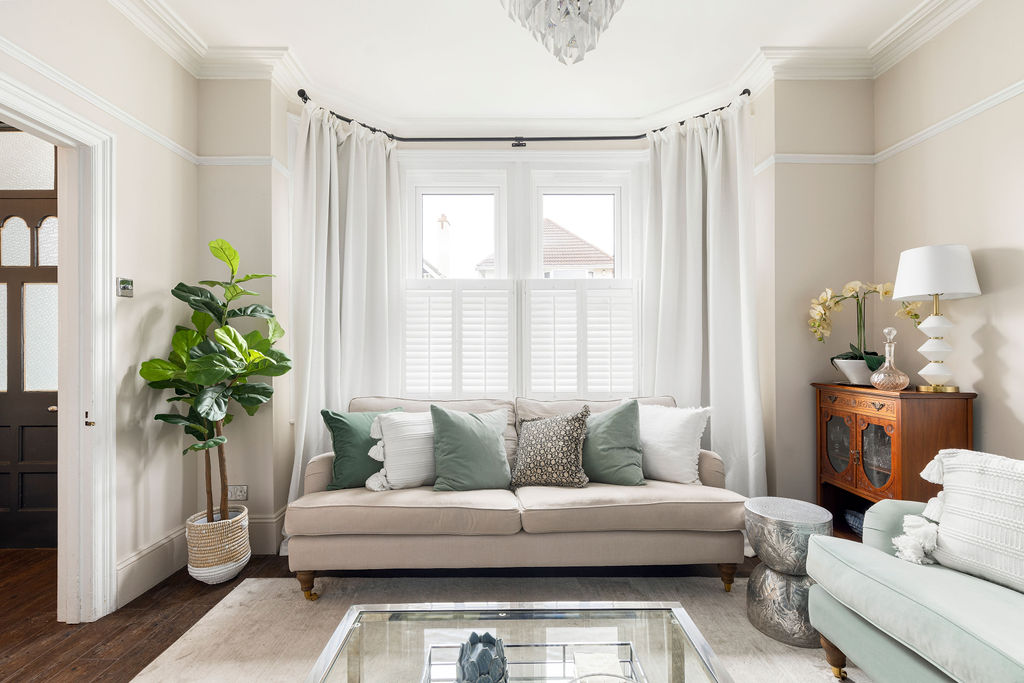
One would think that hanging curtains up should be simple. You buy a pair of drapes you love, slap a rod on the wall, and call it a day, right?
Well, not quite. Be honest with yourself: have you ever hung a fresh pair of curtains only for your room to suddenly feel shorter, darker, and intrusive on floor space? You probably have.
Window treatments are the ultimate secret weapon in an interior designer’s toolkit. When done right, they soften hard architectural lines, frame your view, elevate your ceiling height, and add luscious texture to a plain wall.
Ready to dress your windows in style? Here is our foolproof guide to hanging curtains for an elegant finish!

1. Nail Your Curtain Length
Before we even look at hanging hardware, let’s talk about the bottom hem. Nothing ruins a room scheme faster than curtains that hang awkwardly 10 centimetres above the floor! It visually chops your wall in half and makes the whole space feel stunted.
When it comes to curtain drop lengths, we rely on three classic finishes:
- The Tailored Float (1cm off the floor): If you like clean lines, high functionality, and easy vacuuming, aim for your curtains to hover roughly 1cm above the flooring. It creates a crisp, contemporary look without collecting dust bunnies.
- The Gentle Kiss (Touching the floor): The gold standard for modern homes. The fabric lightly grazes the floorboards or carpet, creating a continuous, unbroken vertical line that stretches the height of your walls.
- The Puddle (5cm to 10cm extra fabric): For a romantic, cosy, or traditional feel, choose curtains that spill elegantly onto the floor. Designer warning: Puddled drapes look gorgeous in low-traffic bedrooms, but they’re high-maintenance in living rooms with pets or active toddlers!
2. Choosing the Right Header Style for Your Vibe
How the top of the curtain attaches to the track or rod, or the header, dictates how the fabric drapes and folds down the wall.
Matching your header style to your room’s aesthetic is crucial:
Pinch Pleat & Wave Headers (Sleek & Tailored)
Pinch pleats feature sewn-in gathers at the top, while Wave (or Ripplefold) headers create smooth, uniform S-curves. Both options feel high-end and fall in neat, structured folds. They work brilliantly on ceiling-mounted tracks or hidden recessed channels for a hotel-luxe vibe.
Eyelet / Grommet (Modern & Casual)
Featuring metal rings built directly into the fabric, eyelet curtains slide straight onto a visible curtain pole. They’re effortless to open and close, making them a great option for everyday living rooms and kids’ bedrooms.
Rod Pocket & Tab Tops (Best Left to Sheers)
While rod pockets look lovely in country cottages, they tend to gather tightly on the pole and don’t slide easily. Reserve rod pockets or delicate fabric tab-tops for sheer cafe curtains or decorative panels you don’t plan on pulling shut every evening.
3. Don’t Skimp on Fabric Volume (The Fullness Formula)
One of the biggest mistakes we see in home decor is buying curtain panels that match the exact width of the window frame. When you pull them closed, the fabric stretches flat against the glass like a bedsheet – zero luxury, zero texture.
To achieve those rich, opulent folds when your curtains are closed, you need to calculate proper fullness.

As a general rule, your total curtain width should be 1.5 to 2.5 times the width of your curtain rod or track.
- Lightweight linen or sheers: Multiply your track width by 2.5 for breezy, billowy folds.
- Heavy velvet or lined cotton: Multiply by 2.0 for structured, full-bodied drape.
4. Layering: Combine Sheers with Blackout Drapes
Why choose between natural light and evening privacy when you can have both? Layering window treatments is the ultimate way to create a multi-dimensional, cosy look that adapts throughout the day.
Try installing a double curtain track system:
- The Inner Layer: A lightweight, translucent sheer (like linen or faux-linen) that stays drawn during the daytime. It diffuses harsh sunlight, prevents glare on screens, and stops passers-by from peering in while still flooding your space with daylight.
- The Outer Layer: A heavy, thermal- or blackout-lined curtain panel in a richer colour or plush texture (like velvet or wool blend). Pull these shut in the evening to lock in warmth, block out streetlights, and cocoon the room in cosy style.

5. Master the Finishing Touch: Train Your Drapes!
Have you ever noticed how brand-new curtains out of the packet like to flare outwards at the bottom?

Fabric has a memory, and fresh out of the box, it hasn’t learned how to fall gracefully yet. Enter an insider designer trick: curtain training.
Once your curtains are hung:
- Use a garment steamer to smooth out any shipping creases (steaming while hanging is much easier than fighting an ironing board!).
- Gently gather the fabric into neat, uniform, vertical pleats from top to bottom.
- Loosely tie three pieces of soft ribbon or fabric strips around the top, middle, and bottom of the curtain column.
- Leave them tied up for 48 to 72 hours.
When you untie the ribbons, the fabric will permanently retain those gorgeous, fluid, vertical folds!
Ready to Elevate Your Windows?
Hanging curtains like a professional designer isn’t about complicated math—it’s all about honouring proportions, giving your fabric room to breathe, and treating your window treatments as a key architectural feature rather than an afterthought!
FAQ:
For a more polished look, hang the curtain pole or track higher than the top of the window frame, ideally closer to the ceiling where the room allows. This draws the eye upward and can make both the window and ceiling feel taller.
In most rooms, curtains should either lightly touch the floor or finish around 1cm above it. A slightly longer puddled finish can suit more traditional or romantic interiors, but it usually requires more maintenance.
The combined curtain width should generally be around 1.5 to 2.5 times the width of the pole or track. Extra fabric creates fuller folds and prevents the curtains from looking stretched flat when closed.
It depends on the look and function you want. Curtain poles are more decorative and work well with eyelet or traditional headers, while tracks create a cleaner finish and are particularly useful for wave curtains, ceiling-mounted designs and layered window treatments.
